Showing posts with label Ferrari Prices. Show all posts

Friday, June 17, 2011

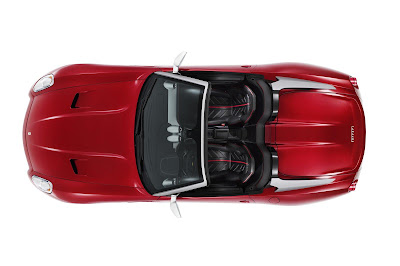
2011 Ferrari Superamerica 45

2011 Ferrari Superamerica 45
Ferrari Superamerica 45 is a one-off prototype, so it may be the world’s most exclusive Ferrari, it is set to make its public debut at the Villa d’Este Concours in Italy on 20th May 2011.Ferrari has released few technical details on the Ferrari Superamerica 45, but it blends elements of the extreme open-top version of the current 599 and the 575M Superamerica,like the 575M Superamerica originally unveiled in 2003, the Ferrari Superamerica 45 gets a novel rotating one-piece roof section.

The Villa d’Este car gets versions of the SA APERTA’s rear buttresses – coloured in the bespoke Blu Antille paint, instead of metallic finish – and double air vents on the front wing. There’s also a unique chrome front grille, plus aluminium A-pillars, wing mirrors and door handles.

Other design features include body-coloured alloy wheels, with a diamond finish on the spokes, and a contrasting dark blue splitter, side skirts and rear diffuser. The main blue paint scheme is designed to match the shade of Kalikow’s 1961 400 Superamerica cabriolet.

Inside, there’s dark blue carbonfibre trim on the dashboard, and Cuoio (deep beige) leather. The boot has been carefully shaped to hide the arrangement when it is open, and is also made of lightweight carbon. The interior meanwhile is trimmed with a combination of Cuoio leather trim and Blu Scuro carbon fibre. It also gets the latest-generation touch-screen infotainment system.

The Superamerica 45 becomes the the latest appear at the Villa d’Este Concorso d’Eleganza. Hosted on the shores of Lake Como, Italy, it’s not the first time, Ferrari has chosen to use the Villa D’Este show to advertise its ability to build bespoke cars. The event was previously used to launch the Ferrari P4/5, created for financier James Glickenhaus.

Thursday, June 2, 2011

2011 Novitec Rosso Ferrari 599 GTO

2011 Novitec Rosso Ferrari 599 GTO
The NOVITEC ROSSO engine specialists have developed an even more powerful version of the proven twin-compressor six-liter four-valve V12 engine for the sport version of the Ferrari 599. Both high-performance superchargers, driven by a cogged V-belt and lubricated by a dedicated oil circuit, were optimized further. Maximum boost pressure is limited to 0.45 bar.

After the engine conversion the 599 GTO is among the most powerful super sports cars in the world. Maximum power output jumps from standard 670 hp / 493 kW to 888 hp / 653 kW at 8,400 rpm, giving the supercharged sports car a power-to-weight ratio of 1.74 kg / hp. The tuned V12 also produces a superlative peak torque, which increases by 242 Nm to 862 Nm at 6,600 rpm.

The NOVITEC ROSSO suspension specialists have developed custom-tailored forged wheels specifically for the Ferrari 599 GTO. In their large size these new wheels are among the lightest of their
kind anywhere in the world. They are anodized a titanium shade and feature five delicate double spokes. The resulting reduction in unsprung weight is crucial for agile handling.

The NOVITEC ROSSO NF4 10Jx21 rim for the front axle weighs just 10.4 kilograms; the size 12Jx22 rear wheel weighs only 13.8 kilograms. In addition to their low weight these wheels also widen the track and
together with the wider Pirelli PZero tires in sizes 295/25 ZR 21 and 335/25 ZR 21 they allow even faster cornering speeds than the production tires.

NOVITEC ROSSO sport springs lower the center of gravity, which also contributes to this effect. An especially useful feature in everyday driving is the front-axle lift function the German specialists have
devised for the GTO. At the push of a button in the cockpit the front can be raised by 40 millimeters. This eliminates the threat posed by speed bumps or underground parking ramps. Upon reaching a speed of 80 km/h the suspension automatically reverts to its original position.

2011 SR Project Ferrari 458 Italia Zeus

2011 SR Project Ferrari 458 Italia Zeus
Distinguishing itself with a gloss black roof to accent the smooth lines of the Novitec aero kit. Project Zeus was just missing the finishing touch, an intimidating voice of it’s own. Sealing the deal was a Akrapovic exhaust system, which releases the raw nature of Project Zeus.

Wheels
Forgiato Aguzzo, Twenty One Inch Front, Twenty Two Inch Rear | Satin Face, Gloss Black Windows

Exterior
Novitec Front Lip Spoiler
Novitec Side Skirts
Novitec Rear Skirts
Novitec Rear Lip Spoiler
Gloss Black Roof

Suspension
Novitec Lowering Springs

Performance
Akrapovic Exhaust System

Tuesday, January 4, 2011

Ferrari Edo Competition Enzo XX Evolution


Ferrari Edo Competition Enzo XX Evolution
INTRODUCTION:Ferrari Enzo is one of the most exclusive and rare cars available on the tuning market with a 6.0-liter 12 cylinder mid-engine berlinetta. Dubbed the Enzo XX Evolution, Edo Competition took it to the next level by increasing the performance with several aftermarket parts. They were able to increase the displacement from 6.0 to 6.3-liters, added new camshafts, connecting rods, titanium valve spring retainers, and then modified the cylinder heads for the displacement increase.

HIGHLIGHT:High performance exhaust headers were installed, along with high flow catalytic converters and a muffler. The stock hydraulic tappets on the Ferrari Enzo were replaced with solid tappets that allow the 12 cylinder Enzo XX Evolution to rev a remarkable 9,600 rpm. Edo Competition was able to boost the Ferrari Enzo to 840 horsepower, while making the vehicle 100 kilograms (220 lbs) lighter.

SPECIFICATIONS:Power and all power – that is the exact term for the 2010 Edo Competition Ferrari Enzo XX Evolution. Power in the sense that should be a mogul in order to purchase it and all power because one has all the right to display such a remarkable piece of metal with the following features:

• 6.3 liter V12 engine
• 840 horsepower at 575 lb-ft @ 5800 rpm torque
• Top speed of over 242 mph
• 3.2 seconds at 0 to 62 mph
• High performance clutch – strada or pista friction pads
• Stainless steel muffler with two different levels or pitch of sound

ENGINE:A bump in displacement from 6.0 to 6.3 liters, new camshafts, new titanium valve spring retainers and connecting rods, modified cylinder heads, new high performance exhaust headers, high flow catalytic converters, mufflers and air filters: that’s the scope of edo competition’s engine modifications. The standard hydraulic tappets are replaced with newly developed solid tappets, enabling the 12 cylinder engine to rev to an incredible 9,600 rpm. This is unmatched by any other 12 cylinder engine at this time! Additionally the intake system of the V12 was modified, a new high performance clutch - available with „strada“ or „pista“ friction pads - and a more powerful oil pump were installed. The power output is increased by 180 to 840 horsepower. Without mufflers more than 860 horsepower is possible. The maximum torque of 780 Nm (575 ft-lb) is available at 5,800 rpm.

DESIGN:The edo/KW race suspension from the FIA GT series was retuned for the Enzo XX Evolution, promising ultimate driving dynamics. The nose lift functionality is retained. The low-friction 3-way adjustable shock absorbers can be adjusted to the individual tastes of the driver and provide excellent steering precision and feedback. The edoinstalled tire pressure monitoring system displays the pressures for each of the four wheels. Providing ample grip for the edo Enzo XX Evolution are 19 inch front wheels and 20 inch rear wheels with 335 mm wide tires. The drive shafts were replaced due to the higher propulsive forces acting on them. The new units are 4 kg (8.8 lb) lighter and considerably more robust in order to cope with the enormous power increase.

CONCLUSION:The Ferrari Enzo XX Evolution received a new rear skirt with rear wing profile adjustable in 3 steps and a retractable rear wing with a taller flap to increase downforce and improve stability. This won’t be the last modified car from Edo Competition so stay tuned for the lastest car tuning news.

Monday, January 3, 2011

Ferrari F60

Ferrari F60
Ferrari F60
Ferrari F60
Ferrari F60
Ferrari F60
Ferrari F60
Ferrari F60
Ferrari F60
INTRODUCTION:The F60 is the fifty fifth single-seater built by Ferrari specifically to compete in the Formula 1 World Championship. The name of the car was chosen to celebrate the Scuderia's participation in all 60 editions of the Formula 1 World Championship since 1950 to date.

HIGHLIGHTS:The car was originally scheduled to be track debuted at nearby Fiorano, but Felipe Massa instead took to the cockpit of the F60 for the first time at Ferrari's other circuit, Mugello, after the launch. Massa said he was pleasantly surprised about the appearance of the F60.

SPECIFICATIONS:
Chassis
Carbon-fibre and honeycomb composite structure
Ferrari longitudinal garbo Limited-slip differential
Semiautomatic sequential electronically controlled garbo - quick shift
Number of gears 7 + Reverse
Brembo ventilated carbon-fibre disc brakes
Independent suspension, push-rod activated torsion springs front and rear
Weight (with water, lubricant and driver) 605 kg
BBS Wheels (front and rear) 13"
Kinetic energy recovery system by Ferrari in cooperation with Magneti Marelli

Engine
Type 056
Number of cylinders 8
Cilinder block in cast aluminium V 90°
Number of valves 32
Pneumatic distribution
Total displacement 2398 cm3
Piston bore 98 mm
Weight > 95 kg
Magneti Marelli digital electronic injection
Magneti Marelli static electronic ignition
Fuel Shell V-Power ULG-66L/2
Lubricant Shell

DESIGN:The design also takes into account two other significant changes in the 2009 regulations: the possibility of using a kinetic energy recovery system (KERS) and the reintroduction of "slick" tyres. The KERS on the F60 was designed by Ferrari in collaboration with Magneti Marelli and is centrally mounted on the engine under the rear part of the chassis; its management has involved all departments of the Gestione Sportiva. The return to tyres with no grooves is another element which is down to the work of the OWG, as is the introduction of a flap on the front wing that can be adjusted by the driver when the car is moving.

CONCLUSION:The F60 also sees a return of slick tires, as well as the use of the optional Kinetic Energy Recovery System (KERS). Ferrari’s KERS has been designed jointly with Magneti Marelli and is centrally mounted on the engine under the rear part of the chassis. Other details include a seven-speed transmission and a redesigned Type 056 V8 engine that must last three races in accordance with the new regulations. Max rpm has also been reduced from 19,000 to 18,000 revs.

Saturday, October 16, 2010

2010 Ferrari SA Aperta 599 Roadster

2010 Ferrari SA Aperta 599 Roadster2010 Ferrari SA Aperta 599 Roadster
This is a special series model of which a strictly limited number of just 80 will be built. All have already been sold. Ferrari chose to build 80 SA APERTAs in celebration of Pininfarina's 80th anniversary. The SA nomenclature also pays homage to both Sergio and Andrea Pininfarina whose company and work have been linked to the most successful road-going cars ever built at Maranello.

The SA APERTA is a true roadster which allows its occupants to enjoy the superlative emotions afforded by our signature front-engined V12 architecture in a completely open-top setting. In fact, it has just a light soft top designed to be resorted to only if the weather gets particularly bad. A low-slung windscreen and the fact that it crouches lower to the ground than our other models lend the SA APERTA an exceptionally aerodynamic sleekness. Its profile arches back from the A-post to two aerodynamic fins beautifully integrating the two roll-bars which themselves cleverly mimic the outline of the seats.

The chassis has been redesigned to deliver a standard of stiffness comparable to that of a closed berlinetta and there is a negligible weight difference also, thanks to work done on the chassis structure.

Thanks to the 670 CV engine beneath its bonnet, the SA APERTA beautifully embodies the sporty spirit of the 599, incorporating Ferrari's most advanced technology to deliver absolutely benchmark performance and superb driving pleasure.

Saturday, October 9, 2010

ferrari mondial t

ferrari mondial T
ferrari mondial t
ferrari mondial T
ferrari mondial t
ferrari mondial T
ferrari mondial t
ferrari mondial T
ferrari mondial t
ferrari mondial T
ferrari mondial t
The final Mondial evolution was 1989's Mondial t. It was a substantially changed model, "spearhead of a new generation of V8 Ferraris", according to Road & Track magazine. The "t" called attention to the car's new engine/transmission layout: though the previously-transverse engine was now mounted longitudinally, the gearbox remained transverse, forming a "t". This configuration was used by Ferrari's Formula 1 cars of the 1980s, and would be the standard for the marque's future mid-engined V8 cars, beginning with the 348, introduced later in the year.

That transverse gearbox was a dual-clutch design with beveled gears driving the axles. The engine was up to 3.4 L (3405 cc) and 300 hp. The Mondial's chassis would underpin a new generation of 2-seat Ferraris, right up to today's 360, but the 2+2 Mondial would end production just four years later in 1993. The company has not produced a mid-engined 2+2 car since, leaving the front-engined V12 456 as the company's only 4-seat car.

The Mondial was home to other Ferrari firsts: It used power brakes for the first time, and had a 3-position electronically controlled suspension. It also had standard antilock brakes, though other Ferraris had this feature as wel

Thursday, September 9, 2010

Ferrari 328 GTB and GTS

Ferrari 328 GTB and GTS

Ferrari 328 GTB and GTS

Ferrari 328 GTB and GTS

Ferrari 328 GTB and GTS

Ferrari 328 GTB and GTS

Ferrari 328 GTB and GTS

The Ferrari 328 GTB and GTS were introduced in the late 1985 early 1986 years. Depending upon who you talk with this model is sometimes considered the last of the 308 series and sometimes a unique model of its own.

The major change from the 308 to the 328 was an increase in engine size from 3.0 to 3.2 which was the reason for the model name change. This increase gave the car 270 bph at 7,000 rpm. Like the earlier 308s the engine was mounted cross wise in a mid engine position.

From the outside the front and rear bumpers were now painted the same as the body color, rather than black as on the 308s. Initial tires were 205/55 front and 225/50 rears. This was identical to late model 308s for the American market. One unique problem with this tire arrangement was that the front spare tire compartment would only accommodate the 205/55 front tire. So if you had a flat in the rear, your spare tire was the wrong size. If you insisted in using it, your next problem was that you could not close the hood on the 225/50 rear tire as it was just too large to fit the cavity.

Top speed was claimed 158mph just as the QV before it. However, it was slightly faster in 0 to 60 mph by 2 tenths of a second. You could feel the extra horsepower and torque while driving the 328, even though the acceleration numbers did not suggest it.

In addition to the change in paint on the bumpers there were dozens and dozens of minor changes to the car. Towards the end of the run, ABS was introduced. One way of telling was the change in the wheels; however some late 328s had the later wheels but not ABS.

1,348 GTBs were produced and 6,068 GTSs from 1985 until 1989. The open top car was much more popular as can be seen from the production numbers. On the open market they also bring about $5,000 more for a used car. The interesting thing though is that the closed GTB was a little better handling, because of its extra stiffness. The downside was the GTB was also much warmer inside as the open top model allowed some of the heat from the radiator pipes to escapee.

The 328 was the last model Ferrari to use the cross engine location in the mid engine position. Its successor, the 348 had the engine switch to a longitudinal design. It has always been a slight controversy as to which engine position was better. One fact is true however, major engine work on the 308 and 328 series can be done with the engine remaining in the car. Later Ferrari cars had to have the engine removed.

Ferrari 288 GTO

Ferrari 288 GTO
Ferrari 288 GTO
Ferrari 288 GTO
Ferrari 288 GTO
Ferrari 288 GTO
Ferrari 288 GTO
Ferrari 288 GTO
Ferrari 288 GTO
Ferrari 288 GTO
Ferrari 288 GTO
The 288GTO, along with its arch-rival the Porsche 959, is a supercar milestone. For most of the ’70s and early ’80s ultimate road car power and performance figures had remained on a plateau. Brake horsepower in the mid/late 300s, 160-175mph and 0-60 in the low ‘fives’ were the benchmark. Then in 1982 the FIA introduced Group B, for 200-off race and rally machines, and the world went homologation-crazy. A new dawn was breaking and when Maranello’s protagonist finally appeared at the 1984 Geneva Show, the overblown ‘Testosterossa’, latest and lardiest in a series of imperious, range-topping 12-cylinder berlinettas, found its thunder nicked by this upstart V8 underling.

With 400bhp on tap (thanks to the emergent art of turbocharging), 60mph took under five seconds and 190-plus was a reality. These were magic figures 20 years ago, a quantum leap forward that continued exponentially as GTO begat F40, and F40 begat F50, and F50 begat Enzo, and…well, who knows? So what makes the iconic GTO special – and justifies its £185k value – even in the cosy, claustrophobic confines of Middle England?

Giorgetto Giugiaro once generously described Leonardo Fioravanti’s 308GTB as “the most perfect car I’ve ever seen” and the 288, if anything, improves on it, with its swollen arches and 110mm-longer wheelbase (to accommodate a longitudinal rather than transverse engine, for easier pit-lane servicing). Unlike the all-steel 308, the GTO’s bodywork is an exotic cocktail of GRP, Kevlar, Nomex, aluminium and steel, saving 140kg. The most beautiful of all Ferraris? It makes a good case for itself. Aside from the ravishing basic shape, detailing is superb. Look, for example, at the three inclined vents behind the rear wheelarches (a homage to the car’s legendary 250GTO forebear) – functional, simple, inspired. As is the interior. Like many low-slung exotics, a dignified, pain-free entry requires a sort of corkscrew action to ensure clearing both sills and roof. Inside, there’s lots of black velvety fabric trim, creating a purposeful, minimalist ambience that’s also light and airy, thanks to the generous fenestration. You sit a bit low in relation to the classic three-spoke wheel – no airbags here – but the leather seats are supportive and comfy (initially at least – after an hour or two my buttocks weren’t so sure).

The twin-turbo V8 is based on the 268C engine developed by Ferrari from the 308 for the Lancia LC2 Group C car, its 2,855cc capacity chosen to provide a nominal four litres under the FIA’s equivalency rule for turbo engines (multiply by 1.4).

Thursday, September 2, 2010

Ferrari 308 GT4 "Dino"

308 GT4
308 GT4 "Dino"
Ferrari 308 GT4
308 GT4 "Dino"
Ferrari 308 GT4
308 GT4 "Dino"
Ferrari 308 GT4c
308 GT4 "Dino"
Ferrari 308 GT4
308 GT4 "Dino"
The 308 GT4 Dino was a radical departure for Ferrari, employing the design house Bertone as opposed to Pininfarina to produce a striking modern cutting edge shape to replace the 246 Dino.

Bertone were responsible for classic designs such as the Lamborghini Miura, the Alfa Romeo GT Junior and rally legend Lancia Stratos. The car is a two plus two so it is practical if you’ve got small kids or need to take some (small) mates out for a pose. In classic red, the Ferrari 308 GT4 Dino is a real show stopper and was bought from a classic car hire company who were updating their stock.
SPECIFICATIONS
  • The Dino brand of mid-engined, rear-drive sports cars was produced by Ferrari from 1968 to 1976
  • The car was an attempt by Ferrari to produce a relatively low cost sports car by using components from other vehicles
  • The Dino brand was reserved for cars with engines with fewer than 12 cylinders. This meant that the Ferrari name was kept for the V12 and flat 12 models
  • The Dino is named in honour of Enzo Ferrari’s son, Alfredo ‘Dino’ Ferrari. He and engineer Vittorio Jano influenced his father’s decision to produce a line of V6 and V8-engined racing cars in the 1950s. Dino died of muscular dystrophy on June 30, 1956 at the age of only 24
  • Initially branded as a ‘Dino’ model, the 308 GT4 was produced from 1973 to April 1980. It was Ferrari's first V8 production automobile
  • The 308 GT4 featured the Dino badge until May 1976. At that point, it began to display the Ferrari ‘Prancing Horse’ badge on the steering wheel, bonnet and wheels
  • The 308 has a wedge shaped, angular design, which makes it look very different from the 206/246 (from which it was derived). It was styled by Italian automobile company Bertone
  • The 308 GT4 V8 has a 90 degree, dual overhead camshaft, a 2927cc motor with four Weber carburetors, V-8 block and heads made of aluminum alloy, and weighs in at 2535 pounds